


Your jawline plays a crucial role in defining your facial aesthetics and overall appearance. In this comprehensive guide, we’ll explore everything you need to know about jawline types, from scientific classification methods to practical enhancement techniques.
You’ll learn how to identify your jawline type, understand cultural variations, and discover natural ways to enhance it. Plus, we’ll answer common questions about attractiveness standards and what your jawline might reveal about your personality.
The jawline, or mandible contour, is the lower edge of your face that extends from your chin to below your ears. It’s one of the most defining features of facial structure and plays a significant role in overall facial aesthetics. Understanding jawline types helps you appreciate your unique features and make informed decisions about enhancement options.
The 8 Major Types of Jawlines (Male & Female)


- Square Jawline: Characterized by a broad, angular jaw with a flat chin and prominent jaw angles. This type creates a strong, masculine appearance and is often considered highly attractive in men.
- Convex Jawline: Features a rounded, protruding jaw that curves outward. This type creates a fuller facial profile and is common across various ethnicities.
- Heart-Shaped Jawline: Wider at the temples and gradually narrows to a pointed or slightly rounded chin. This creates a feminine, delicate appearance.
- Diamond-Shaped Jawline: The rarest type, featuring narrow forehead and chin with wider cheekbones. Diamond-shaped jawlines are very rare, especially in men, according to beauty standards (Source: wikihow.com).
- V-Line Jawline: Popular in Asian beauty standards, this type features a slim, tapered jaw that forms a V-shape from the ears to the chin.
- Concave Jawline: Characterized by an inward curve or depression along the jaw angle, creating a softer profile.
- Angular Jawline: Features sharp, defined angles with minimal curves, creating a chiseled appearance.
- Flat Jawline: Has minimal definition with a straight line from ear to chin, lacking prominent angles or curves.
The Science of Jaw Shapes: Obtuse Angle Jawlines & Measurements
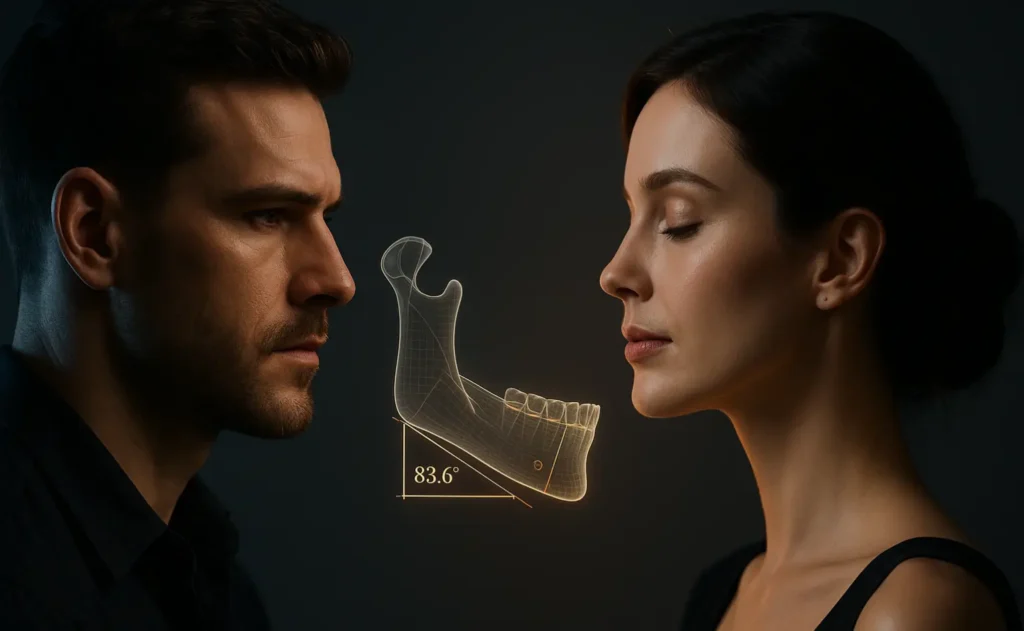
Jawline classification isn’t just about aesthetics—it’s rooted in anatomical measurements and geometric analysis. The gonial angle, which is the angle formed where your jaw meets your neck, plays a crucial role in determining your jawline type. The ideal gonial angle for women in fashion and beauty industry is between 120-130 degrees, similar to men’s ideal angle (mewing.coach). This measurement helps professionals assess facial harmony and plan enhancement procedures.


Your jawline type is influenced by several factors including genetics, bone structure, muscle development, and fat distribution. Understanding these elements helps you appreciate why certain enhancement methods work better for specific jawline types.
How to Identify Your Jawline Type (Front & Side Profile)
Identifying your jawline type doesn’t require professional help—you can do it at home with simple techniques. Here’s a step-by-step guide to determine your jawline classification.
Find your Face Shape Instantly : Face shape detector online
Step-by-Step Identification Process:
- Gather Your Tools: You’ll need a mirror, good lighting, a camera or smartphone, and optionally a measuring tape or protractor for precise measurements.
- Take Profile Photos: Capture clear photos of your face from the front and both sides. Make sure your hair is pulled back and you’re in natural lighting.
- Observe Key Features: Look at these characteristics:
- Width of your jaw compared to your forehead
- Shape of your chin (pointed, rounded, or flat)
- Prominence of jaw angles
- Overall jaw contour (curved or angular)
- Measure Your Gonial Angle: Place your fingers at the point where your jaw meets your neck. The angle formed here indicates your jawline type. Angles below 120 degrees suggest a more angular jawline, while angles above 130 degrees indicate a softer, rounder jaw.
- Compare with Reference Images: Match your observations with the 8 major jawline types described earlier.
Self-Assessment Checklist:
- Is your jaw wider than your forehead? (Square or angular)
- Does your jaw taper significantly toward your chin? (Heart-shaped or V-line)
- Are your cheekbones the widest part of your face? (Diamond-shaped)
- Is your jaw relatively straight without prominent angles? (Flat)
- Does your jaw curve outward? (Convex)
- Does your jaw curve inward at the angles? (Concave)
Common Jawline Identification Mistakes:
Many people confuse face shape with jawline type. Your face shape (oval, round, square) is determined by multiple factors including forehead width and cheekbone prominence, while your jawline type specifically refers to the lower jaw contour. Also, facial fat can mask your true bone structure, so consider your jawline when you’re at a healthy weight for accurate identification.
Jaw Types Male vs. Female: Key Differences

Male Jawlines
Men typically have more angular, prominent jawlines with gonial angles around 120-130 degrees. Square and angular jawlines are considered most attractive in men because they’re associated with masculinity and strength. A strong jawline is associated with higher testosterone levels and perceived as more attractive due to biological conditioning.
In India, Bollywood actors like Hrithik Roshan and John Abraham are known for their defined, angular jawlines.
Female Jawlines
Women generally have softer, more rounded jawlines with slightly wider gonial angles. Heart-shaped and V-line jawlines are often preferred in women as they create a feminine, delicate appearance.
Indian actresses like Deepika Padukone and Priyanka Chopra showcase different but equally attractive jawline types that complement their facial features. Read more about how you can enhancing your face shape.
Evolution of Beauty Standards:
Beauty standards aren’t static—they evolve with time and cultural exchange. Social media and global connectivity have created more inclusive beauty ideals that celebrate diverse jawline types. In India, there’s growing movement toward accepting natural features rather than conforming to rigid standards.
Did You Know? Fascinating Facts About Jawlines
1. Personality Insights: Jawline shape can reveal personality traits—strong jawlines suggest determination and leadership, while softer jawlines indicate empathy and creativity (timesofindia). This connection between facial structure and personality has been studied in various psychological research.
2. Rarity Factor: Diamond-shaped jawlines are extremely rare, especially in men, making them one of the most unique facial features you can have (The Vou). If you have this jawline type, you’re part of a small percentage of the population.
3. Universal Standards: The ideal gonial angle of 120-130 degrees is remarkably similar for both men and women in the fashion and beauty industry (CBAM). This shows that facial harmony follows certain mathematical principles regardless of gender.
4. Biological Attraction: Strong, defined jawlines are perceived as more attractive because they’re associated with higher testosterone levels and good health (mewing.coach). This biological conditioning influences our perception of attractiveness across cultures.
5. Eight Distinct Types: While faces are infinitely varied, jawlines can be classified into 8 major types that cover the spectrum of human facial structures (wikihow). This classification system helps professionals and individuals understand facial aesthetics better.
Natural Methods to Enhance Your Jawline
If you’re looking to enhance your jawline without surgery, there are several natural methods that can help improve definition and appearance. These techniques work best when practiced consistently over time.
Effective Jawline Exercises to get a better Jawline
Specific exercises can strengthen jaw muscles and improve definition:
- Chin Lifts: Tilt your head back and look at the ceiling. Push your lower jaw forward and hold for 10 seconds. Repeat 10-15 times daily.
- Jaw Clenches: Place your thumbs under your chin and open your mouth while pushing gently against your thumbs. Hold for 5 seconds and repeat 10 times.
- Neck Curls: Lie on your back and lift your head off the ground, bringing your chin to your chest. Hold for 10 seconds and repeat 10 times.
- Tongue Press: Press your tongue against the roof of your mouth while tilting your head back. Hold for 10 seconds and repeat 15 times.
- Ball Exercise: Place a small ball under your chin and press down with your chin. Repeat 25 times daily.
Lifestyle Changes to Make Your Jawline More Defined
Your daily habits significantly impact jawline appearance:
- Weight Management: Maintaining a healthy weight helps reduce facial fat that can obscure your natural jawline. Focus on balanced nutrition with plenty of fruits, vegetables, and lean proteins common in Indian cuisine.
- Hydration: Drinking 8-10 glasses of water daily helps reduce water retention and bloating that can affect facial definition.
- Posture Correction: Good posture, especially keeping your head up and shoulders back, naturally enhances jawline appearance and prevents sagging.
- Sleep Position: Sleeping on your back prevents facial compression that can affect jawline definition over time.
Improving Jawline Through Everyday Foods
Certain foods and nutrients support jawline health:
- Protein-rich foods: Dal, paneer, chicken, and fish help build muscle
- Vitamin C: Citrus fruits and amla support collagen production
- Omega-3 fatty acids: Found in walnuts and flaxseeds, they reduce inflammation
- Reduce sodium: Limit salt intake to prevent water retention
Mewing Technique:
Mewing involves proper tongue posture where you rest your entire tongue against the roof of your mouth. This technique, popularized by Dr. Mike Mew, claims to improve jawline definition over time through consistent practice. While scientific evidence is limited, many practitioners report positive results.
Facial Massage:
Regular facial massage can improve circulation and reduce puffiness:
- Use upward strokes from chin to ears
- Apply gentle pressure along the jawline
- Practice for 5-10 minutes daily
- Use natural oils like coconut or almond oil
Realistic Expectations:
Natural methods require patience and consistency. You won’t see dramatic changes overnight, but with 3-6 months of regular practice, you can notice improvements in muscle tone and definition. These methods work best for enhancing your natural jawline rather than completely changing its structure.
The Psychology of Jawlines: What Makes a Face Attractive?
Beauty is subjective, but science and psychology play a huge role in what we consider “attractive.” When people ask, “What type of jaw is most attractive?” they are usually looking for a mix of biological instincts and modern beauty trends.
1. The “Strong Jawline” Bias (Biological Roots)
Why do we love a sharp jawline? Evolutionary psychology suggests that a strong, defined jawline signals good health and strong genetics.
For Men: A wide, angular jaw suggests higher testosterone levels. This is why the square jawline is traditionally seen as the masculine ideal.
For Women: A tapered, V-line jaw or soft heart shape often signals youth and fertility, which are biological markers for feminine attractiveness.
2. Perception vs. Reality: What Your Jaw Says About You
Humans subconsciously judge personality based on facial features. While not scientifically accurate, these first impressions are powerful:
Sharp & Angular Jaws: Often perceived as dominant, confident, and natural leaders.
Round & Soft Jaws: Often perceived as approachable, trustworthy, friendly, and kind.
3. Is a “Weak Jawline” a Turn-Off?
One of the most common insecurities is having a weak jawline (also known as a recessed chin).
The Truth: A weak jawline is not necessarily a turn-off. While social media praises the “sharpest jawline,” overall facial harmony matters much more. Many attractive celebrities and public figures have softer, recessed chins.
Tip: Confidence and grooming often outweigh bone structure. For men, a well-groomed beard can easily mask a weak jaw, creating the illusion of a stronger jawline instantly.
4. The “Selfie Era” Standard
Modern beauty standards have shifted due to social media. The obsession with the “sharpest jawline” is largely driven by filters and lighting angles used on Instagram and TikTok.
Reality Check: Most “perfect” jawlines you see online are enhanced by lighting, posture (tilting the head up), or editing apps. Real faces have softness, asymmetry, and skin texture.
Daily Habits for a Sharper Jawline
Regardless of your jawline type, maintaining its health and appearance requires consistent care. Here are practical tips for long-term jawline maintenance.
Daily Care Routine:
- Skincare: Use a gentle cleanser and moisturizer suitable for your skin type. Indian brands like Himalaya, Mamaearth, and Plum offer affordable options. Apply sunscreen daily to prevent skin damage and sagging.
- Facial Exercises: Incorporate 10-15 minutes of jawline exercises into your daily routine. Consistency is key for seeing results.
- Proper Hydration: Drink adequate water throughout the day. In India’s climate, aim for 10-12 glasses daily, especially during summer months.
Avoiding Harmful Habits:
Certain habits can negatively impact your jawline:
- Excessive Chewing: Constantly chewing gum can overdevelop jaw muscles, creating a wider appearance
- Teeth Grinding: Bruxism can alter jaw shape and cause pain; use a night guard if needed
- Poor Posture: Slouching and looking down at phones creates a double chin and weakens jaw muscles
- Smoking: Accelerates skin aging and reduces collagen production
Nutrition for Jawline Health:
Eat foods that support skin and bone health:
- Collagen-rich foods: Bone broth, chicken, fish
- Vitamin C sources: Oranges, guavas, amla
- Calcium: Milk, yogurt, paneer, ragi
- Antioxidants: Green tea, berries, dark leafy vegetables
Frequently Asked Questions
Attractiveness is subjective, but generally, symmetrical, well-defined jawlines are preferred. For men, a square jawline (approx. 120-130 degrees) is often seen as masculine and strong. For women, a V-line or heart-shaped jaw is often favored for its delicate, feminine look. Ultimately, the “best” jawline is simply one that balances your unique facial features.
The diamond-shaped jawline is the rarest, especially in men. It features a narrow forehead and chin paired with wide, high cheekbones. If you have this shape, you have a highly unique bone structure. Other rare types include perfectly symmetrical angular jawlines.
No, ChatGPT cannot “see” your face directly. However, if you describe your measurements (forehead width vs. jaw width), it can give you an educated guess. For the most accurate result, use the mirror method or a specialized face-shape app rather than text AI.
Yes, but subtly. While your bone structure is set by your late teens, your face shape can shift due to weight loss (reducing facial fat), muscle growth (from chewing habits), or aging (loss of collagen). Hormonal changes and dental work can also slightly alter your jaw’s appearance over time.
Not necessarily. While social media hypes up “razor-sharp” jaws, a weak jawline (recessed chin) is common and doesn’t define attractiveness. Confidence, grooming (like a well-styled beard), and a friendly smile often matter far more than bone structure. Many celebrities with softer jawlines are considered widely attractive.
Yes, to a degree. You cannot grow new bone, but you can improve definition. Effective natural methods include reducing body fat (to reveal the bone), practicing mewing (tongue posture), and doing jaw exercises to tone the muscles. Results take consistency (3-6 months) but can make a noticeable difference without surgery.
In Chinese face reading (physiognomy), the oval face shape is traditionally considered the luckiest, symbolizing balance and success. Square faces are linked to leadership, while round faces symbolize wealth. Remember, these are cultural beliefs, not scientific facts—your luck is determined by your actions, not your chin.
A weak jawline (or recessed jaw) is one that lacks definition or slopes backward towards the neck. It typically has a soft, rounded angle (over 130 degrees) and minimal separation between the chin and neck. It is often caused by genetics, a small chin bone, or a layer of submental fat masking the bone.
There is no single “winner,” as genetics vary wildly. Scandinavian populations often have angular, sharp features, while East Asian beauty standards heavily favor the V-line look (often achieved through surgery in South Korea). In India, jawlines are incredibly diverse, ranging from sharp Northern features to softer Southern structures.
Famous examples of sharp jawlines include Henry Cavill, Brad Pitt, and Angelina Jolie. In Bollywood, Hrithik Roshan and John Abraham are known for their square, angular jaws. Keep in mind that celebrity photos are often enhanced by professional lighting, makeup, and angles.
Conclusion
Knowing your jawline type—whether square, round, or diamond—is the first step to maximizing your look. While there are 8 different types, no single shape is “perfect.” You can enhance what you have through natural habits like posture correction and grooming, or simply embrace your unique structure. True attractiveness comes from confidence and health, not just geometry.